GUIDENodes, 6 chapters
What is a blockchain node? Types, counts and costs
A blockchain node is a computer that keeps its own copy of a blockchain, checks every new block against the rules, and passes valid data on to other nodes. No single company holds the record: thousands of nodes each hold it, and they agree on it.
That is the textbook part. We also counted real nodes on 26 October 2026: how many Solana and Bitcoin run, and how few of them actually make blocks.
Then the six kinds of node, what each one stores, and a short chooser that tells you which one you need and what it costs.
 HeroRPC teamPublished
- Updated
- Networks counted
- Read
- 8 min
Where do you want to start?
In this guideThe quick answer
Quick answer
What is a blockchain node, in short?
A node is one computer in a blockchain network. It runs the chain's software, stores a copy of the chain, and talks to other nodes.
Every node checks the rules itself. It does not trust a block because another node sent it. A bad block is refused and not passed on.
Only some nodes make blocks. Miners and validators do. Most nodes just store, check and serve the data, for wallets, apps and explorers.
- Keeps a copy of the chain
- Checks every block against the rules
- Passes valid blocks and transactions on
CHAPTER 01
What a blockchain node does, step by step
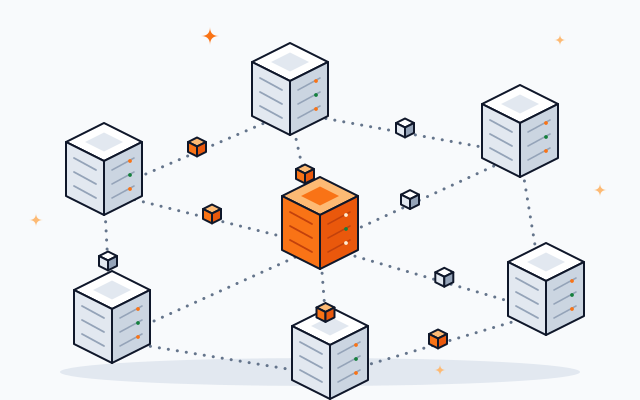
Receive, check, store, pass on. All day, every block.
A blockchain node receives new blocks and transactions from its peers, checks them against the chain's rules, adds the valid ones to its own copy, and forwards them to other nodes. Wallets and apps can also ask it questions about the chain.
- Step 1: ReceivePeers send it new transactions and blocks over the internet.
- Step 2: CheckSignatures, balances, block format, and the chain's own rules, like proof of work or validator votes.
- Step 3: StoreValid blocks are added to its copy. Invalid ones are thrown away.
- Step 4: Pass onIt forwards what it accepted, so the network learns about it within seconds.
This is why a blockchain does not need a bank in the middle. Each node checks for itself, so a cheater would have to fool all of them at once, not one server.
When a wallet shows your balance, it asked a node. Nodes that answer apps like this are called RPC nodes; the RPC node guide shows real requests and answers.
CHAPTER 02
How many nodes are there, and how many make blocks?
We counted on 26 October 2026. Most nodes never make a block.
On 26 October 2026, Solana's network listed 3,927 nodes, and 685 of them were validators: about 17 percent. Bitcoin had 10,016 nodes that accept connections from others. The Cosmos Hub caps its block-signing set at 180 validators.
Solana nodes on 26 October 2026 that do not vote on blocks. They follow the chain, check it and serve data.
| Network | Nodes we could count | Make or vote on blocks | How we counted |
|---|---|---|---|
| Solana | 3,927 | 685 validators | getClusterNodes and getVoteAccounts on Solana's public RPC. 270 nodes also offered a public RPC address |
| Bitcoin | 10,016 reachable | Miners; no public count | The Bitnodes crawler. 2,642 of them were on Tor. Nodes that only connect outward are not counted |
| Cosmos Hub | No public count | 180 active validators | The chain's own staking data |
Two things follow. First, a chain is far more than its block makers: every extra node is one more independent check. Second, running a node does not mean earning from it. Only block makers are paid, and the do nodes earn money guide shows who gets what on seven chains.
CHAPTER 03
The six types of blockchain node

From headers only to every state since block zero.
The main node types are light, pruned, full and archive, which differ in how much data they keep, plus validator (or miner) and RPC, which describe the job a full node does. A full node checks everything; an archive node also keeps every past state.
| Type | What it keeps | Checks every block | Makes blocks | Disk, from official docs |
|---|---|---|---|---|
| Light | Block headers only; asks full nodes for the rest | No, checks proofs against headers | No | Small |
| Pruned | Checks all blocks, then deletes old block files | Yes | No | Bitcoin Core: down to 550 MiB of block files |
| Full | Current state, plus the blocks the chain needs | Yes | No | Ethereum: 2 / 4 TB NVMe |
| Archive | Every past state since the first block | Yes | No | Ethereum: 2.2 TB+ (Reth) to 12 TB+ (Geth) |
| Validator or miner | A full node plus the keys or hardware that make blocks | Yes | Yes | As a full node, often with faster hardware |
| RPC | A full or archive node with its API open to apps | Yes | No | As full or archive |
Checked October 2026. Ethereum full nodes keep state for about the last 128 blocks, per ethereum.org. Hardware for 24 chains is in the node requirements index.
Full or archive: the one that confuses people
Both check every block. The difference is memory. Ask a full node "what was this balance a year ago?" and it usually cannot answer, because it deleted that old state. An archive node can. The archive node guide explains when you need one.
CHAPTER 04
Which blockchain node do you need?
Four yes or no questions, one answer.
If you only use a wallet, you need no node. If your app reads current data or sends transactions, a full node is enough. If it reads old balances or traces, get an archive node. If you want to make blocks and earn, you need a validator.
Question 1: Are you building an app, bot or service, not just holding coins?
NOYou need no node. Your wallet uses one for you
YESGo to 2
Question 2: Do you want to make blocks and earn rewards?
NOGo to 3
YESA validator (stake and risk apply)
Question 3: Do you read balances or contract state at old blocks?
NOGo to 4
YESAn archive node
Question 4: Is your traffic steady, or do rate limits hurt?
NOA shared RPC plan is cheaper
YESA dedicated full node
Not sure about question 4? Put your monthly requests into the break-even calculator in dedicated vs shared RPC and it shows when your own node wins.
CHAPTER 05
Run a node yourself, or rent one?
The software is free. The hours are not.
You can run a node yourself for the price of a suitable server, but you also pay in time: the first sync takes days on big chains, and someone has to apply updates and fix it when it falls behind. Renting gives you the endpoint without that work.
Run it yourself if
- You want full control Your hardware, your settings, your logs.
- Someone has the hours Updates, disk growth and resyncs are ongoing.
- You want to learn Running a node teaches you how the chain works.
Rent one if
- Uptime matters A paid node comes with a backup and monitoring.
- The chain is heavy Archive and Solana nodes need costly hardware.
- Time is money You want the endpoint today, not after a week.
The Ethereum node cost guide adds up the real monthly bill of running one yourself, hardware and hours included.
CHAPTER 06
What each node type costs on HeroRPC
One flat monthly price per node, by type.
On HeroRPC a dedicated full node costs from $139 a month, an archive node from $289, and a validator node from $219. Each runs on its own server with a backup, and is ready within 24 hours of payment.
| Node type | From | Good for |
|---|---|---|
| Full | $139/mo | Apps, wallets, bots and payment backends |
| Archive | $289/mo | Explorers, analytics, tax and audit tools |
| Validator | $219/mo | Staking on proof of stake chains |
Prices vary by chain. Each chain page shows its exact price.
You pay in crypto, get the server logins, and keep your keys. Pick a chain on dedicated nodes or compare them all on node pricing.
QUESTIONS
Blockchain node questions
What is a node in blockchain, in simple words?
A computer that keeps a copy of the blockchain, checks every new block against the rules, and passes valid data to other computers in the network.
What is the difference between a node and a miner or validator?
Every miner or validator runs a node, but most nodes are not miners or validators. A node checks and stores the chain; a miner or validator also makes new blocks.
How many nodes does Bitcoin have?
On 26 October 2026 the Bitnodes crawler could reach 10,016 Bitcoin nodes, 2,642 of them on Tor. The real number is higher, because nodes that only connect outward cannot be counted.
Do blockchain nodes get paid?
Usually not. Plain full nodes are not rewarded. Miners, validators and masternodes can be, and they put up hardware, stake or collateral and take on risk.
How is a light node different from a full node?
A full node downloads and checks every block. A light node keeps only block headers and asks full nodes for the rest, checking their answers against those headers. Light nodes need very little disk.
Can I run a blockchain node at home?
For Bitcoin, yes: a pruned node fits on a small disk. Ethereum needs a fast 2 to 4 TB NVMe drive and 16 to 32 GB of memory. Solana needs data center hardware.
Which node do I need for my app?
A full node if you read current data and send transactions. An archive node if you read old balances or states. A shared RPC plan may be cheaper if your traffic is small.
ABOUT
How we made this guide
On 26 October 2026 we called getClusterNodes and getVoteAccounts on Solana's public mainnet RPC and counted the results, read the latest Bitnodes snapshot for Bitcoin, and took the Cosmos Hub validator cap from the chain's staking data. Counts change all the time. Node type sizes come from the projects' own docs and code, the same figures as our node requirements index. HeroRPC prices are our own list prices.
Written by
Written and checked by the people who run HeroRPC's builder and node servers. Every figure links to its source.
Published . Last updated .
Get a node without the upkeep
A dedicated node on its own server, from $139 a month. Pick a chain and a type, pay in crypto, and it is ready within 24 hours.