GUIDEListings, 9 chapters
New coin listing: how to get your coin on an exchange
A new coin listing is a ladder, not a button. Price trackers come first, then a place where your coin can trade, then a small exchange, and only then the big names. Each rung checks different things, and the ones that matter most are free to apply to.
We read the listing pages of Coinbase, Kraken, Binance, CoinMarketCap, CoinGecko and a small exchange that lists new blockchains, and wrote down what each one actually asks for and charges today.
If your coin runs on its own blockchain, there is extra work the token guides skip: an exchange has to run your node before it can take a single deposit. This guide covers that too.
 HeroRPC teamPublished
- Updated
- Listing rules checked
- Read
- 11 min
Where do you want to start?
In this guideThe quick answer
Quick answer
How do you list a new coin?
First, get tracked on CoinGecko and CoinMarketCap. Both need a working website, a block explorer and at least one market where the coin trades.
Next, give your coin that market: your own swap on a smart-contract chain, or a small exchange that lists new blockchains.
Then apply to bigger exchanges through their official forms. Coinbase and Kraken say they charge no listing fee. Anyone selling you a guaranteed listing is not working with them.
- Trackers: free to apply, paid fast tracks exist
- Small exchanges: published fees from $3,499
- Coinbase and Kraken: no listing fee
CHAPTER 01
The listing ladder, rung by rung
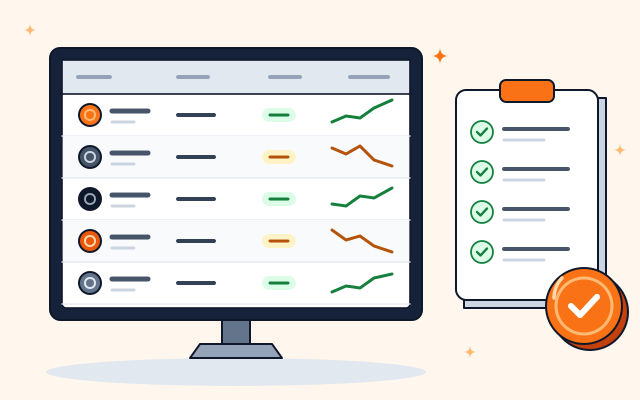
Four rungs, and each one needs the one below it.
Listing goes in four steps: price trackers, a first market, a small exchange, then a large exchange. Each step needs the one below it, because every venue checks that your coin already trades and has real users.
- Step 1: Price trackersCoinGecko and CoinMarketCap pages. Free to apply. They want a website, an explorer and a live market.
- Step 2: A first marketA swap on your own chain, or one small exchange. This gives your coin a public price.
- Step 3: Small exchangesMore markets and more buyers. Many publish their fees and list in days.
- Step 4: Large exchangesCoinbase, Kraken, Binance. Free to apply, slow to review, and they look for demand you can show.
Question 1: Is your coin live, with a public block explorer anyone can use?
NOLaunch the chain and its explorer first
YESGo to 2
Question 2: Can people buy and sell it somewhere today?
NOOpen a first market (chapter 4)
YESGo to 3
Question 3: Is it on CoinGecko or CoinMarketCap?
NOApply to the trackers (chapter 3)
YESApply to bigger exchanges (chapter 5)
The order is not a rule anyone wrote down. It falls out of the requirements: the trackers want a market, and the big exchanges want trading volume and holders before they spend engineering time on you.
CHAPTER 02
What changes when your coin has its own blockchain
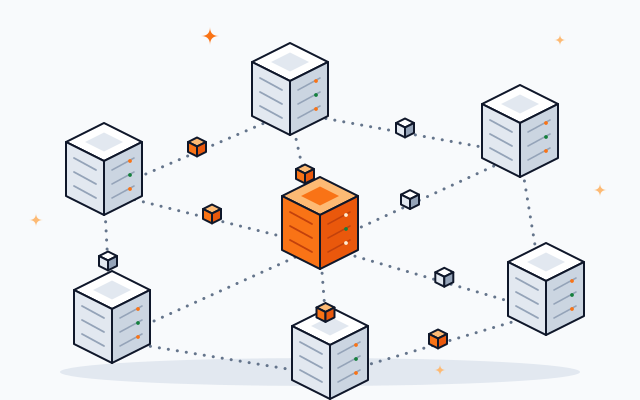
The exchange has to run your node. That takes engineering time.
A token on Ethereum or Solana can be added by an exchange that already supports that network. A coin with its own blockchain cannot: the exchange has to run your node, learn your address format and build a new integration, so big exchanges say it takes longer.
Coinbase says new or unsupported chains take longer because its engineers build "custom node infrastructure" and new tooling for each one. For new blockchains, it reviews the technical design, consensus, network resilience and governance. Kraken says unsupported or novel chains add engineering lead time.
A small exchange does the same work at a smaller scale. One that lists new blockchains asks for a block explorer and says your wallet software must pass a security review before it lists you.
Have this ready before any exchange asks
Node software
A public download or source link, with release notes for each version.
A block explorer
So their staff and your holders can check every deposit.
Wallet software
Clean, current and documented. Expect a security review.
Confirmations
How many blocks a deposit should wait before it is safe to credit.
Address format
What a valid address looks like, so wrong deposits are caught.
Upgrade notice
A promise to warn exchanges well before every network upgrade.
CHAPTER 03
Step 1: get on CoinGecko and CoinMarketCap
Free to apply. They want a market before they show a price.
CoinGecko and CoinMarketCap are free to apply to. Both want a working website, a block explorer and an exchange where the coin already trades. Both also sell faster reviews: $1,000 for a CoinGecko Fast Pass and $5,000 for a CoinMarketCap Priority listing, with no promise of approval.
CoinMarketCap's criteria ask for a functional website and block explorer, active trading with material volume on at least one exchange it tracks, and a contact person from the project. It says the free route can take "days to months/years" and that meeting the guidelines does not guarantee a listing.
The paid routes speed up the review, not the decision. CoinGecko's Fast Pass gets a coin listing request looked at within 24 hours, and you pay it whether or not you are approved. CoinMarketCap Priority works the same way, and only for a coin that already trades on an exchange feeding data to CoinMarketCap.
Every CoinGecko requirement, quoted and explained, is in our guide on how to get listed on CoinGecko.
CHAPTER 04
Step 2: give your coin its first market

Your own swap, or one small exchange.
A brand new chain has no exchange on it yet. On a smart-contract chain you can open your own swap and seed it with your coin and a base token. A Bitcoin-style coin has no smart contracts, so its first market is usually a small exchange that lists new blockchains.
On a smart-contract chain: your own swap
If your coin runs on an EVM, Cosmos or Avalanche base, a swap on your own chain is the first place anyone can trade it. The swap add-on is $599 one-time. A bridge ($999) lets holders bring in tokens from bigger chains to trade against it.
On a Bitcoin-style chain: a small exchange
Small exchanges that take new blockchains often publish their prices. NonKYC, for example, lists a new coin from $3,499 for a known codebase such as a Bitcoin fork, $4,499 for another codebase and $9,999 for a custom design, and asks for $400 of locked liquidity for each market.
Check how long an exchange has been running and who runs it before you pay anyone. A small exchange holds your holders' coins, and if it fails, so does your only market.
CHAPTER 05
Step 3: apply to the big exchanges
Official forms only. Free, slow, and demand comes first.
Coinbase, Kraken and Binance each take applications through one official form. Coinbase and Kraken say listing is free. All three review legal, security and demand, and none promises an answer or a date.
| Exchange | Fee to list | How to apply | Timing they state |
|---|---|---|---|
| Coinbase | None | Online questionnaire on its listings page | About 1 week of review, usually under 30 days to listing; new chains take longer |
| Kraken | None, and no paid fast track | One application per asset, through its form | Reply in about 2 weeks; 2 to 6 weeks after approval for most EVM tokens; novel chains longer |
| Binance | Not stated | Direct listing form, filled in by the founder or CEO | No timing; most applicants are contacted only if they pass |
What they look at
Coinbase asks for your whitepaper, team, tokenomics, source code, block explorers and any audits, then runs legal, compliance and technical security reviews. After that it weighs demand: trading volume, holders, active wallets and community.
Binance says it has "no set requirements" but wants a proven team, a useful product and a large user base, and that you should not apply without at least a minimum viable product. It asks for a one-way NDA at first contact.
Kraken weighs market cap and liquidity, market fit, technical and security strength, regulatory posture and community. In the EU it also needs a MiCA whitepaper, filed with a regulator at least 20 business days before listing. Our crypto whitepaper guide covers that rule.
CHAPTER 06
What a new coin listing really costs
Free at the top, published fees at the bottom, and liquidity everywhere.
Applying to Coinbase, Kraken, CoinGecko and CoinMarketCap is free. The trackers sell optional fast reviews ($1,000 and $5,000). Small exchanges that list new blockchains publish fees, such as $3,499 to $9,999 at NonKYC. The cost most people forget is liquidity: the coins and money you put up so trades can happen.
| Venue | Fee | What it buys |
|---|---|---|
| Coinbase | None | A review; listing if approved |
| Kraken | None | A review; listing if approved |
| CoinGecko | Free, or $1,000 Fast Pass | Fast Pass: a reply within 24 hours, no approval promised |
| CoinMarketCap | Free, or $5,000 Priority | Priority: about 24 business hours, coin must already trade |
| NonKYC (new blockchain) | $3,499 / $4,499 / $9,999 | Listing in 3 to 7 days, plus $400 locked liquidity per market |
From each venue's own page, checked October 2026. Binance does not publish a fee.
Many fee figures you will find elsewhere, such as "tens of thousands to a million dollars", come from reports written around 2018 and are not stated by the exchanges themselves. Treat them as history, not prices.
The costs around the listing
- Liquidity for every market and every pool you open
- A market maker, if an exchange asks for steady order books (Coinbase offers referral discounts on these)
- Legal advice on whether your coin could count as a security
- A MiCA whitepaper if you want to be listed in the EU
- A security audit of your contracts or wallet, if you have them
CHAPTER 07
Listing scams and red flags
Guaranteed listings are the oldest trick in the book.
Nobody can guarantee you a listing. Coinbase, Kraken, Binance and CoinMarketCap all say they take applications only through their own forms, and all warn about people who claim inside connections.
"Guaranteed listing"
CoinMarketCap keeps a public list of services that promised listings through insiders.
"We have a deal with them"
Binance says anyone claiming a listing agreement with it is lying or breaking it.
"Pay us to skip the queue"
Kraken says it has no paid fast track, and anyone claiming one is not affiliated with it.
A message out of the blue
Exchanges contact you through their own ticket or email. Check the domain letter by letter.
CHAPTER 08
Your listing application checklist
Tick these off before you send a single form.
Before you apply anywhere, have a live chain with a public explorer, a website on your own domain, published supply numbers, a whitepaper, wallet software, at least one market and a named contact person.
Writing the whitepaper? See how to write a crypto whitepaper. Setting the supply? See tokenomics.
CHAPTER 09
What HeroRPC does, and what it does not
We build the chain and the tools. Listings are your call.
HeroRPC builds the parts every listing form asks about: your blockchain, its block explorer, wallets and, on smart-contract chains, your own swap and bridge. We do not run an exchange, sell listings or promise one.
The block explorer is $149 one-time, the web wallet $149 and the desktop wallet $199 for Bitcoin-style coins. See every add-on on the add-ons page.
Still choosing between a coin and a token? Coin vs token explains why the listing work is different for each.
QUESTIONS
New coin listing questions
How much does it cost to list a coin on an exchange?
Coinbase and Kraken say they charge no listing fee. CoinGecko and CoinMarketCap are free, with optional fast reviews at $1,000 and $5,000. Small exchanges that take new blockchains publish fees, for example $3,499 to $9,999 at NonKYC, plus locked liquidity.
How long does a new coin listing take?
A small exchange can list in days. Coinbase says its review averages about 1 week and listing usually follows within 30 days, while Kraken says 2 to 6 weeks after approval for most EVM tokens. New blockchains take longer at both.
Can I list a coin on Coinbase?
Anyone can apply through the Coinbase listings page, for free. Coinbase reviews legal, compliance and technical security, then demand. A coin with its own blockchain needs a new integration, which Coinbase says takes longer.
Do I need to be on CoinMarketCap before an exchange?
No. It is the other way round: CoinMarketCap and CoinGecko want your coin to trade on an exchange they track before they show a price.
Can a coin with its own blockchain trade on Uniswap?
Not directly. Uniswap runs on Ethereum and similar chains. Your coin would need a bridge that issues a wrapped version there, or its own swap on your chain.
Is a listing service worth paying for?
Paying someone to fill in forms is legal but rarely needed. Paying for a "guaranteed" listing is the warning sign: the exchanges and trackers say no one can promise one.
ABOUT
How we made this guide
In October 2026 we read the listing pages of Coinbase (its September 2025 guide and its fee statements), Kraken, Binance, CoinMarketCap (criteria and Priority prices), CoinGecko (Fast Pass) and NonKYC, a small exchange that lists new blockchains. We quote each venue's own words and dates. We did not apply anywhere, and no venue paid or reviewed this page.
Written by
Written and checked by the people who run HeroRPC's builder and node servers. Every figure links to its source.
Published . Last updated .
Build what the listing forms ask for
Your own blockchain with an explorer and wallets, launched automatically after payment.