Quick answer
The short answer
To get listed on CoinGecko, your coin needs a working website you own with clear information, a working block explorer, a listing on at least one active exchange CoinGecko is integrated with, and a clearly communicated circulating supply. Then you fill out CoinGecko's request form. Meeting the criteria does not guarantee a listing, and CoinGecko will not explain a rejection.
- Step 1: A website you ownWith real information about purpose, team or social profiles. No website builders.
- Step 2: A working block explorerAnyone can look up blocks and transactions.
- Step 3: An exchange listingAt least one active exchange that CoinGecko is integrated with.
- Step 4: Circulating supplyStated clearly, including locked and team coins.
- Step 5: The request formFilled out on CoinGecko, then you wait.
Four requirements and a form. Each one has a trap for a new coin, so here is what they mean in practice.
CHAPTER 01
What a CoinGecko listing is, and what it is not
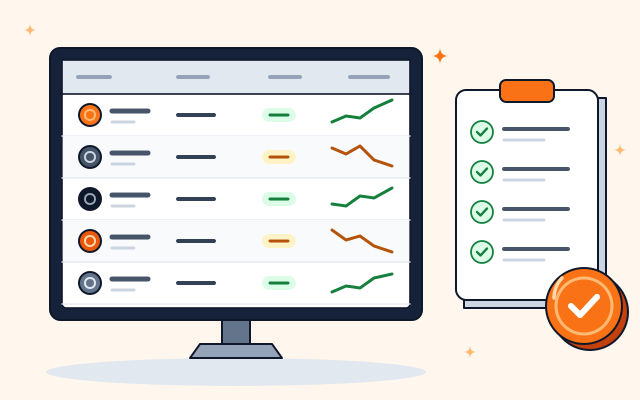
A listing gives your coin a page with price and supply data. It is not an endorsement, and it is not an exchange.
CoinGecko is a site that tracks coins, prices and exchanges. A listing means your coin gets its own page with price, supply and links. It does not mean your coin can be bought there, and it does not mean CoinGecko recommends it.
22,204
cryptocurrencies were tracked by CoinGecko when we looked on 13 October 2026. The count changes daily.
Source: CoinGecko
That is a lot of coins, but CoinGecko still reviews each request. Its methodology page says that fulfilling the criteria "does not automatically guarantee a listing" and that it looks at "many other factors" too.
CHAPTER 02
The official requirements, and what they mean for your coin

Four requirements from CoinGecko's methodology page, each translated into a to-do for a new coin.
These come from the cryptoasset listing criteria in CoinGecko's methodology. We checked the page on 13 October 2026. Rules can change, so read it again before you apply.
| What CoinGecko asks for | What it means for a new coin | Where HeroRPC fits |
|---|---|---|
| A working, functional website with sufficient information on the cryptoasset | A site with what the coin is, why it exists, the team or social profiles, and links to the explorer and wallets | You build the website. Our guides can help you plan what to put on it |
| The website must be owned by the project, and builder sites such as Wix are not accepted | Your own domain on your own hosting. No free site builder | Not covered. This is yours to set up |
| A working block explorer | A public page where anyone can look up blocks, transactions and addresses | The explorer is an add-on in the builder |
| Listed on at least one active exchange CoinGecko is integrated with | Your coin must trade somewhere CoinGecko already pulls data from | Not covered. Each exchange has its own process |
| Circulating supply communicated clearly | A public number for coins in circulation, and what is locked, held by the team or vested | Plan it with the tokenomics guide |
Criteria quoted or paraphrased from CoinGecko's methodology page. The "where HeroRPC fits" column is ours.
Website
The page says websites with "no information on purpose, team or social media profiles" are considered invalid. Write plainly what your coin is for. A whitepaper published on your own site is a good home for the details.
Block explorer
This is the requirement a coin with its own blockchain meets most easily, because the chain is yours to expose. Our builder deploys an explorer for your coin and hosts it, and it is one of the add-ons. Check that it is reachable from your website and that it shows your coin's name and units.
Exchange and circulating supply
The exchange rule has a catch. The page says projects traded only on self-serviceable centralized or decentralized exchanges "may be rejected due to security concerns". In plain terms: a market anyone can set up themselves may not be enough. Circulating supply is how CoinGecko calculates market cap, so it asks that anything held by "company/foundation/team/developers", vesting or locked coins be made clear.
CHAPTER 03
The order of operations

Launch first, then the website and community, then an exchange, then the form. Doing it backwards wastes time.
- Step 1
Launch the chain with an explorer
The coin must exist, run on several nodes and have a public explorer. With HeroRPC, deploying takes about 30 minutes after payment.
- Step 2
Publish your website
On your own domain. Add purpose, team or social profiles, the explorer link, wallet downloads and the supply numbers.
- Step 3
Build real activity
Wallets in use, a faucet or pool if you run one, a community that can answer questions. See how to mine your own cryptocurrency.
- Step 4
Get on an exchange
Contact exchanges that fit a young coin. Each has its own rules. CoinGecko must already be integrated with it.
- Step 5
Fill out the request form
Use the form linked from the methodology page. Every detail should match your website and explorer.
Notice what is not on the list: paying someone. Exchanges set their own terms, and that is a separate conversation from CoinGecko's review.
CHAPTER 04
Rejection, scams and shortcuts
What the official page says about rejection, and why listing sellers cannot keep their promise.
CoinGecko does not publish a long list of rejection reasons. What it does say on its methodology page is short and useful:
Websites that do not qualify
No information on purpose, team or social profiles, not owned by the project, or built on a website builder such as Wix.
Weak exchange listing
Projects traded only on self-serviceable exchanges may be rejected due to security concerns.
No explanation
CoinGecko will not provide an update if a project fails any part of the review process.
Paid shortcuts
The page lists, under "Don't", accepting any offer from others who claim they can expedite or guarantee your listing.
That last line matters. People who sell "guaranteed listings" are selling something CoinGecko says nobody can sell. If you are offered one, walk away.
CHAPTER 05
What about CoinMarketCap?
A separate site with its own criteria and its own request form. Do not assume the same steps.
CoinMarketCap is a separate site with its own listing criteria and its own request form. Read its current criteria on CoinMarketCap itself before you apply, because they are not the same as CoinGecko's. We could not verify its requirements from an official page, so we do not list any here.
The groundwork overlaps, though: a real website, a working explorer, clear supply numbers and a market. Do those once and both applications get easier.
Ready to build the part you can control?
The explorer and wallets are the part of this list you can finish today. Our builder launches a coin with its own blockchain from $149 one-time, with the explorer and wallets as add-ons. You see the full price in the builder.
QUESTIONS
Questions people ask
How do I get my coin listed on CoinGecko?
Make sure your coin meets the published criteria: a working website you own, a working block explorer, a listing on at least one active exchange CoinGecko is integrated with, and a clear circulating supply. Then fill out the CoinGecko request form.
What are the CoinGecko listing requirements?
A working website with sufficient information that the project owns (not a website builder), a working block explorer, a listing on an active exchange CoinGecko is integrated with, and a clearly communicated circulating supply.
Does meeting the requirements guarantee a listing?
No. CoinGecko says fulfilling the criteria does not automatically guarantee a listing, and it evaluates other factors too. It also says it will not provide an update if a project fails any part of the review.
Can a new coin with its own blockchain be listed?
Yes, if it meets the criteria. Having your own blockchain makes the block explorer requirement straightforward, but you still need your own website, an exchange listing and a clear circulating supply.
Do I need to pay CoinGecko to be listed?
CoinGecko's methodology page tells projects not to accept offers from people claiming they can expedite or guarantee a listing. Check the page for the current rules before paying anyone.
Why was my coin rejected?
CoinGecko does not give feedback. Common problems from its own criteria are a website without enough information, a website on a website builder, no working explorer, or trading only on self-serviceable exchanges.
How do I list a coin on CoinMarketCap?
CoinMarketCap has its own criteria and its own request form, separate from CoinGecko. Read its current requirements on its site before applying.
Can I list a coin before it trades anywhere?
CoinGecko's criteria ask for a listing on at least one active exchange it is integrated with, so a coin that trades nowhere does not yet meet them.
SOURCES
Sources and how we made this guide
- CoinGecko methodology, cryptoasset listing criteria (website, block explorer, exchange, circulating supply, no guarantee, request form, "Don't" list. Re-read 13 October 2026)
- CoinGecko home page (number of cryptocurrencies tracked, seen 13 October 2026)

Written by
Written and checked by the people who run HeroRPC's builder and node servers. Every figure links to its source.
Published . Last updated .