GUIDEBlockchain basics, 6 chapters
What is a 51 percent attack? Real attacks, and how coins defend
A 51 percent attack is when one miner, or a group, controls more than half of a coin's mining power. With that much power they can secretly build a longer chain, then release it and erase recent payments. The classic goal is to spend the same coins twice.
It is not just theory. We list 8 attacks that really happened, from Bitcoin Gold to Monero, with how many blocks each one replaced and a link to the report.
Then the numbers that matter if you run or build a coin: how much hash power anyone can rent today, and how many confirmations keep a payment safe.
 HeroRPC teamPublished
- Updated
- Figures checked
- Read
- 10 min
Where do you want to start?
In this guideThe quick answer
Quick answer
What is a 51 percent attack, in short?
It is a takeover of a mined coin's history. Whoever holds most of the mining power can mine a secret chain faster than everyone else, then publish it. Nodes switch to the longest chain, so recent blocks are replaced.
The usual prize is a double spend. The attacker deposits coins at an exchange, sells them, withdraws something else, then publishes a chain where the deposit never happened.
Big coins are hard to attack, small ones are not. Rented hash power can easily outweigh a young coin's whole network.
- Can erase recent payments
- Cannot take coins from your wallet
- Waiting for more blocks is the first defense
CHAPTER 01
How a 51 percent attack works, step by step
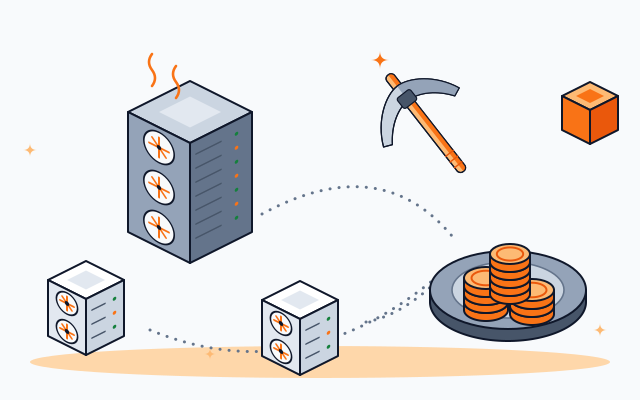
A secret chain, a deposit, and a reveal.
A 51 percent attack works because nodes always follow the chain with the most work behind it. An attacker with most of the hash power mines a hidden chain, spends coins on the public one, and then releases the hidden chain. The public payment disappears and the coins are theirs again.
- Step 1: Mine in secretThe attacker starts mining their own version of the chain and does not share it.
- Step 2: Spend on the public chainThey send coins to an exchange or a merchant and wait until the deposit is credited.
- Step 3: Take something awayThey trade the coins for another currency and withdraw it.
- Step 4: Release the longer chainTheir hidden chain has more blocks, so every node switches to it. In that history, the deposit was never made.
Replacing blocks like this is called a reorganization, or reorg. Its depth is the number of blocks thrown away. Small reorgs of one or two blocks happen by accident when two miners find a block at nearly the same time. Deep ones almost never do, which is why Coinbase calls deep reorgs a sign of attack in its Ethereum Classic report.
What an attacker can and cannot do
| Action | Can they? | Why |
|---|---|---|
| Reverse their own recent payments | Yes | They choose which transactions go in their chain |
| Block some transactions from being confirmed | Yes | They make most of the blocks and can leave them out |
| Spend coins in your wallet | No | That needs your private key, which mining does not give |
| Create coins beyond the rules | No | Nodes reject blocks that break the rules, however long the chain |
| Rewrite very old history cheaply | No | Each older block means more work to redo |
So the damage lands on whoever accepted a payment too early, almost always an exchange. Ordinary holders keep their coins, but the price usually suffers and exchanges may stop trading the coin.
CHAPTER 02
Real 51 percent attacks, with how deep they went
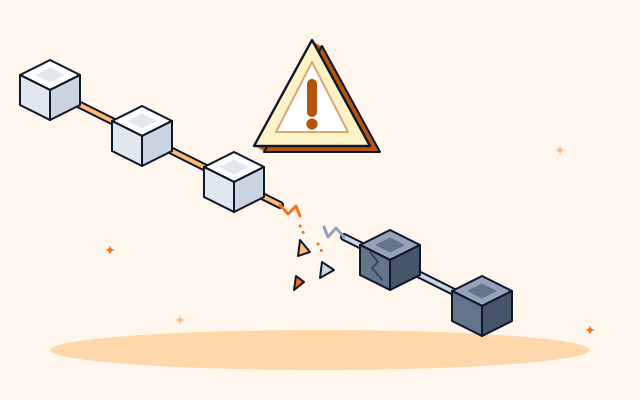
8 attacks from 2018 to 2025, each with its report.
Coins hit by majority attacks include Bitcoin Gold (twice), Ethereum Classic (four times across 2019 and 2020), Vertcoin, Firo, Bitcoin SV and Monero. Reorgs ranged from 14 blocks to over 7,000. Nearly all of the money taken came from exchanges.
- May 2018
Bitcoin Gold: depth not reported
Exchanges were tricked into crediting deposits that were later erased; the loss was put at over 18 million dollars of BTG. Report.
- Jan 2019
Ethereum Classic: 15 reorgs
Coinbase counted 15 deep reorganizations, 12 with double spends, worth 219,500 ETC. It paused ETC sends and receives until March. Report.
- Dec 2019
Vertcoin: 603 blocks
The attack replaced 603 blocks, just past the 600 confirmations its biggest exchange waited for. Workers on a hash rental market were being sent the hidden blocks to mine. Report.
- Jan 2020
Bitcoin Gold: 14 and 15 blocks
Two reorgs in two days double-spent about 7,167 BTG, found by MIT's reorg tracker. Report.
- Aug 2020
Ethereum Classic: 3,693 to over 7,000 blocks
Three attacks in one month: 3,693 blocks, then 4,000, then over 7,000, about two days of mining. Report.
- Jan 2021
Firo: over 300 blocks
The attacker sold 865,951 FIRO on an exchange, then released a secret chain that erased the deposits. Firo capped reorgs at 5 blocks and switched on ChainLocks. Report.
- Aug 2021
Bitcoin SV: 14 blocks or more
Several competing chains were mined at once. Node operators were told to mark the attacker's blocks invalid by hand. Report.
- Sept 2025
Monero: 18 blocks
The Qubic mining pool released a hidden chain from block 3,499,659, erasing 118 transactions, about 36 minutes of history. Report.
reorgs of 6 or more blocks detected on smaller mined coins in 2019 and 2020
Two patterns repeat. The victims are coins whose mining algorithm is shared with bigger coins or sold on rental markets. And the attack depth is chosen to beat the exchange: the Vertcoin attack replaced 603 blocks, just past the 600 confirmations its main exchange waited for, per MIT's write-up.
CHAPTER 03
Why small mined coins are the targets
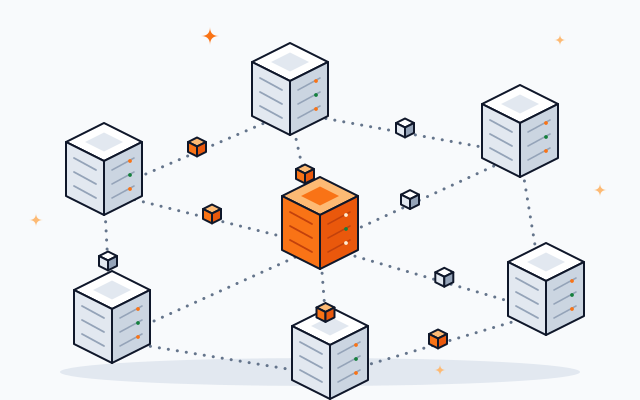
Rented hash power is tiny next to Bitcoin, and huge next to a new coin.
Anyone can rent mining power by the hour on marketplaces such as NiceHash. On the day we checked, the SHA-256 power mining there was 1.4 percent of Bitcoin's, far too little to attack Bitcoin. A new coin on the same algorithm can have less hash power than that in total.
| Algorithm | Mining on NiceHash | Biggest coin | Its network | Rental as share |
|---|---|---|---|---|
| SHA-256 | 15.6 EH/s | Bitcoin | 1,076 EH/s | 1.4 percent |
| Scrypt | 233 TH/s | Litecoin | 2,736 TH/s | 8.5 percent |
| X11 | 28 TH/s | Dash | 4,681 TH/s | 0.6 percent |
NiceHash figures are the speed mining through its orders at the time of the check; more hardware can join when buyers pay more. Dash's network figure is worked out from its difficulty and 150 second blocks.
EH/s, TH/s: units of mining speed. One EH/s is a million TH/s, so Bitcoin's network is millions of times bigger than any small SHA-256 coin.
The lesson for a new coin: if your whole network is smaller than the power for rent on your algorithm, someone can outmine you for a few hours. On day one, every new mined coin is in that position. That is what MIT's researchers found too: many smaller coins had several times their own hash power available to rent.
Pools: the other way to reach a majority
Miners join pools to get steady payouts, and pools can grow large. Over the past week, the top three Bitcoin pools found 63.6 percent of blocks, per mempool.space; on Litecoin the top two found 55 percent, per litecoinspace. A pool is many independent miners who can leave, so this is not the same as one owner, but it is why the community watches pool shares closely.
CHAPTER 04
How many confirmations keep a payment safe?

The whitepaper's own formula, in a calculator.
Against an attacker with less than half the hash power, each extra confirmation makes reversal less likely. The Bitcoin whitepaper shows that with 10 percent of the power, 5 confirmations bring the attacker's chance under 0.1 percent; with 30 percent, it takes 24. With half or more, no number of confirmations is enough.
| Attacker's share | 10% | 20% | 30% | 40% | 45% |
|---|---|---|---|---|---|
| Confirmations | 5 | 11 | 24 | 89 | 340 |
Section 11 of the Bitcoin whitepaper. The calculator above runs the same formula.
This is why exchanges set confirmations per coin. Big coins with spread-out mining get a handful. After an attack, the number jumps: when Coinbase reopened ETC deposits in March 2019, it warned they could take a day or more to credit, because so many blocks were now required.
CHAPTER 05
How coins defend against 51 percent attacks
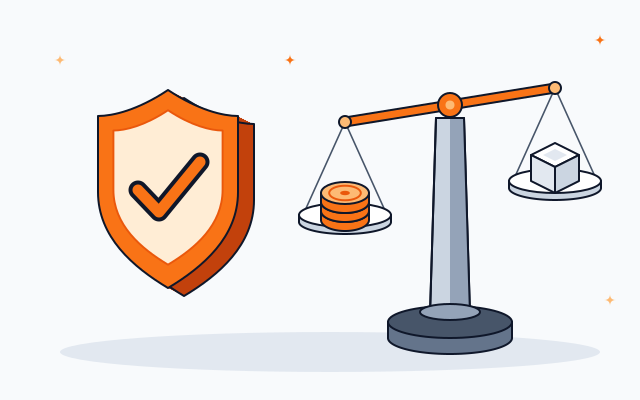
Five defenses, from the cheapest to the deepest change.
The defenses are: more confirmations at exchanges, a limit on how deep a reorg may go, signed block locks from masternodes (Dash's ChainLocks), merged mining with a bigger coin, and leaving mining behind for proof of stake. Most coins that were attacked added one of these afterwards.
- Exchanges
More confirmations
The cheapest fix: credit deposits later. It does not stop a majority, but it makes the attack longer and dearer.
- Node rule
A reorg limit
Nodes refuse to replace more than a set number of blocks. After its attack, Firo capped reorgs at 5 blocks, per its post-mortem. The catch: nodes that see different chains first can end up split.
- Masternodes
ChainLocks
On Dash, a group of masternodes signs each new block, and nodes then refuse anything that would replace it. Dash's docs say at least 240 of a 300 to 400 member quorum must sign. Firo switched them on after its attack.
- Shared security
Merged mining
Miners of a bigger coin mine yours at the same time, at no extra cost. Dogecoin has been merge-mined with Litecoin this way, so attacking it means outmining much of Litecoin's power too.
- No mining
Proof of stake
There is no hash power to rent. An attacker would need most of the staked coins, and on chains like Ethereum, validators caught signing conflicting blocks lose part of their stake.
After the Aug 2020 attacks on Ethereum Classic, Coinbase raised its ETC confirmation count sharply; Bitcoin SV told node operators to mark the attacker's blocks invalid by hand. Fixes added in a hurry tend to be rougher than ones planned before launch. For the bigger choice between mining and staking, read proof of work vs proof of stake.
CHAPTER 06
Launching a coin that is hard to attack
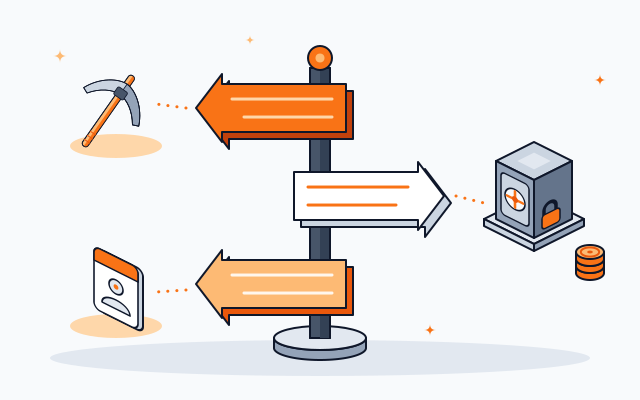
Pick the base with the attack in mind.
HeroRPC launches your own coin from $149 one-time. If 51 percent attacks worry you, pick a staked base such as Ethereum-style, Cosmos or PIVX, where there is no mining to rent. If you want a mined coin, plan honest mining early and tell exchanges to wait for plenty of confirmations.
Question 1: Do you want people to mine your coin with their own hardware?
NOA staked chain: no hash power to rent
YESGo to 2
Question 2: Will you run masternodes, like Dash?
NOGo to 3
YESA Dash fork, with ChainLocks once enough masternodes run
Question 3: Can you bring miners from day one, through a pool or a community?
NOReconsider: a staked chain is safer while you grow
YESA mined fork, with high exchange confirmations at first
A young Dash fork starts with few masternodes, so its ChainLocks only become strong once enough of them run. Growing honest mining is easier with a mining pool your miners can join from day one. To compare bases, see the best coin to fork, or open the builder to see the full price for each.
QUESTIONS
51 percent attack questions
What is a 51 percent attack in simple terms?
When one miner or group controls more than half of a coin's mining power, they can rewrite recent blocks. They use this to reverse their own payments and spend the same coins twice.
Can Bitcoin be 51 percent attacked?
In theory, yes; in practice it would take an enormous amount of hardware. On the day we checked, all the SHA-256 power mining through NiceHash was 1.4 percent of Bitcoin's network, so renting is not an option.
Can a 51 percent attack steal coins from my wallet?
No. Spending your coins needs your private key, and mining power does not give anyone that. The attacker can only reverse payments they made themselves.
Has Ethereum ever been 51 percent attacked?
Ethereum has not. Ethereum Classic, the chain that kept mining after the 2016 split, was attacked in 2019 and three times in August 2020. Ethereum itself moved to proof of stake in 2022, so it has no hash power to rent.
Can proof of stake be 51 percent attacked?
An attacker would need most of the staked coins, not rented hardware. Buying that much pushes the price up, and chains like Ethereum destroy part of the stake of validators caught cheating.
How many confirmations are safe?
It depends on how much of the hash power an attacker could get. Against 10 percent, 5 confirmations bring the risk under 0.1 percent; against 30 percent, 24. Exchanges set higher numbers for small coins.
Is a new coin safe from 51 percent attacks?
A new mined coin is the easiest target, because its network is small. A staked chain, merged mining, or masternode block locks lower the risk.
ABOUT
How we made this guide
Each attack in the timeline comes from the report linked to it: Coinbase's own write-up, the Firo team's post-mortem, MIT's reorg tracker, or the news report that measured it. On October 2026 we read the hash power mining through NiceHash per algorithm, Bitcoin and Litecoin network hash power and weekly pool shares from mempool.space and litecoinspace, and worked out Dash's from its difficulty. The confirmations figures come from section 11 of the Bitcoin whitepaper.
Written by
Written and checked by the people who run HeroRPC's builder and node servers. Every figure links to its source.
Published . Last updated .
Launch a coin built to last
Mined or staked, your own coin from $149 one-time. Pick a base, set your rules, see the full price before you pay.